For The World's Most Beautiful Watches

At PaddleWaves, we love everything horology. We want to provide an expert service in terms of scholarship, transparency and above all we want our community to buy the very best the market has to offer.

FOR THE
WORLD'S MOST
BEAUTIFUL
WATCHES

SHOP NOW

Current Selection

Patek Philippe 5004
Patek Philippe 5004
Patek Philippe 5004
Crown of Patek Philippe 5004
Sideview of Patek 5004
Casebook of Patek 5004

Patek Philippe ref.5004 in Rose Gold

The Patek Philippe Ref. 5004 is a watch that leaves an immediate impression. Measuring only 36.7 mm in diameter yet approximately 15 mm thick, with an unusually prominent crown, its proportions are impossible to overlook—and every one of these features exists for a reason.

The Ref. 5004 was Patek Philippe’s first serially produced perpetual calendar split-seconds chronograph. A perpetual calendar, moon-phase display, and rattrapante chronograph would each be sufficient to define an important watch in its own right. Bringing all three together in a single wristwatch made the 5004 an uncompromising feat of high watchmaking.

Its technical character is expressed most clearly through the movement. The 5004 was developed from the CH 27-70 Q found in the perpetual calendar chronograph Ref. 3970, with the addition of a split-seconds mechanism. To isolate the stopped rattrapante assembly from the chronograph train that continues to run, Patek Philippe incorporated an exceptionally complex mechanical system, inevitably adding to the movement’s thickness. The resulting calibre was designated CHR 27-70 Q, with the added “R” standing for rattrapante. In effect, the 5004 pushed the architecture of the perpetual calendar chronograph to its mechanical limit.

Patek Philippe also sought to preserve the traditional design language of its perpetual calendar chronographs, particularly the classic “pusher–crown–pusher” arrangement on the right side of the case. Rather than adding a separate split-seconds pusher at 10 o’clock, the rattrapante control was integrated coaxially into the crown. This ingenious solution also explains the crown’s unusually substantial proportions.

Total production of the Ref. 5004 is believed to have remained below approximately 1,000 pieces, with rose-gold examples accounting for only around 20 percent of the total. Drawing upon the dial architecture of the Ref. 1518—most notably its prominent Arabic numerals—while inheriting the mechanical foundation of the Ref. 3970, the 5004 can be understood as a watch that pushed classical Patek Philippe form to the very limits of mechanical complexity.

Sales Status
    AVAILABLE
$0.00
Patek Philippe 1415
Patek Philippe 1415
Bezel of Patek Philippe 1415
Detail of Patek Philippe 1415
Patek Philippe 1415
Sideview of Patek Philippe 1415

Patek Philippe ref.1415 in Yellow Gold

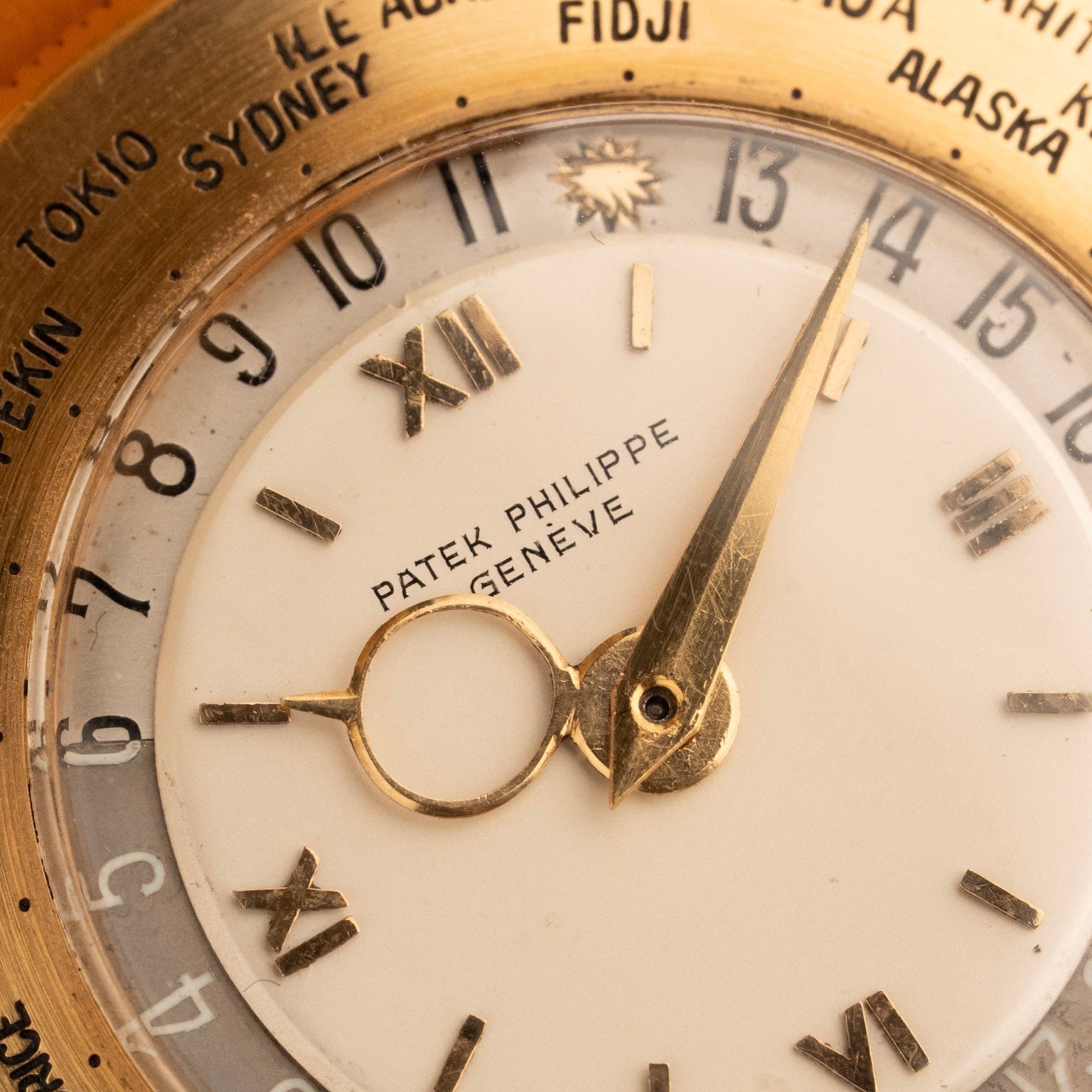
The reason Patek Philippe’s first-generation World Time, the reference 1415, feels so powerful is that it was born at what seemed to be the least appropriate moment for such an object to exist.

In 1939, as the Second World War began and the world started to fall apart, this small wristwatch placed London, Paris, Berlin, Peking, Chicago, Tokyo, and Geneva together on a single dial. The World Time mechanism invented by Louis Cottier was not merely a stroke of technical genius. It was also a deeply romantic idea: even as war was tearing the world open, we could still choose to understand it as a whole.

Technology can be used to destroy life, but it can also become a vessel for the continuity of civilization. The 1415 World Time was not an object made to conquer the earth. Within its small body, it quietly preserved the order that civilization requires: cities still had names, day and night still had rhythm. As you were waking up, someone else was just falling asleep.

Sales Status
    AVAILABLE
$0.00
Rolex Day-Date 18168 ruby

Rolex Day-Date "Ruby" ref.18168 in Yellow Gold

The Ref. 18168 is an exceptionally rare artistic creation from Rolex’s high-jewellery repertoire of the 1980s. A bezel of baguette-cut rubies lends the watch a sense of strength and architecture, while ruby hour markers punctuate the champagne-coloured dial. Even the day and date displays are rendered in deep red to echo the gemstones. Between them runs a brilliant circle of diamonds, which continues along the centre links of the President bracelet. In red, gold and white—in rubies, yellow gold and diamonds—the watch composes an elaborate tableau for the wrist.

This may well be the only ruby-set Ref. 18168 currently visible on the market. Yet for all its splendour, it is never loud. The deep crimson of the rubies plays against the mellow warmth of a champagne-gold dial softened by time, like Burgundy wine casting its shadow across a piece of antique gold.

Sales Status
    AVAILABLE
$0.00
Rolex_6238_Pre_Daytona
Dial of Rolex 6238 Pre_Daytona

Rolex Pre-Daytona ref.6238 in Stainless Steel

If the Daytona represents the modern pinnacle of Rolex chronographs, then the Ref. 6238—the celebrated “Pre-Daytona”—is the watch in which that achievement first gathered momentum.

The 6238 forms a vital bridge between Rolex’s traditional chronographs and the modern Cosmograph. On one side, it retains the monochromatic dial, tachymeter scale printed around the dial’s perimeter, and smooth metal bezel of its predecessors. On the other, it introduces a more modern visual language: clean baton hands, sculptural applied hour markers, and recessed subdials framed by pronounced bevelled slopes. By simplifying and refining the traditional chronograph, and by introducing a greater sense of open space across the dial, the 6238 acquired a distinctly modern sporting character and helped usher in the era of the Daytona.

Far rarer than the familiar silver-dial examples, black-dial 6238s account for fewer than five percent of an estimated total production of only two to three thousand pieces. This particular dial was also produced using the celebrated “gilt” technique: a black lacquer layer was applied over a golden metallic base, leaving selected areas uncovered so that the inscriptions appear naturally in gold. Viewed closely, the effect is remarkable. Against the deep, lustrous black surface stand the hard, sculptural forms of the silver-toned hour markers, while the golden lettering beneath the lacquer shifts and glows with the light.

The dial is additionally signed “-T SWISS T-,” indicating the use of tritium rather than radium as its luminous material.

This is a Rolex chronograph capable of stirring the imagination of any serious collector—a masterpiece in its own right, and an indispensable prologue to the Daytona.

Sales Status
    AVAILABLE
$390,000.00
Patek Philippe ref.3506
Patek Philippe 3506
Casebook of Patek Philippe 3506
Patek Philippe 3506

Patek Philippe ref.3506 in White Gold

Ref. 3506 is nicknamed the “Skater” by some collectors, though “Skier” may be more apt. The symmetrical rows of diamonds flanking the case resemble a pair of skis, while the watch itself appears almost to glide along its silk-like bracelet. Composed in white gold and diamonds, the Ref. 3506 is Patek Philippe’s ode to ice and snow.

How does it achieve this effect?

First, through proportion. The horizontally oriented rectangular case leaves ample room for the bracelet to assert itself. The baguette diamonds on either side stretch the eye laterally, while the bracelet runs vertically across the wrist. These opposing forces hold one another in tension, creating a composition that feels both dynamic and perfectly balanced.

Then there is the construction of the case. The bracelet is not simply attached directly to it. Where conventional lugs might be expected, a pair of triangular structures folds inward and gradually disappears behind the bracelet. By cleverly exploiting the Gestalt principle of visual continuity, Patek Philippe creates the illusion that the case has been slipped over the bracelet, rather than joined to it. A view from the back reveals that this is not, in fact, how the watch is constructed.

We may not know the identity of its designer, but it is clear that every element was carefully considered. The bracelet and the watch head of the Ref. 3506 may technically be separate components, yet in design terms they are inseparable. Long before the arrival of the integrated-bracelet sports watch, Patek Philippe had already created something subtler and, arguably, more ingenious: a watch conceived as a complete and indivisible whole.

Sales Status
    AVAILABLE
$0.00
Rolex Day-Date 18366 in platinum
Dial detail of Rolex Day-Date ref.18366 in platinum

Rolex ref.18366 in Platinum

This is Rolex casting a sky full of stars across the Day-Date.

Ref. 18366 is crafted in quietly luxurious platinum, with a pavé diamond dial of tiny white diamonds forming a vast celestial field, while sapphire hour markers shine like fixed stars within it. The clean, transparent baguette-cut diamond bezel resembles a crystal palace encircling a nebula.

It stands apart from the familiar image of the Day-Date as an authoritative and conservative “President’s watch.” Instead, it represents a rare aesthetic expression from Rolex’s small-production, high-jewellery creations of the 1990s.

Platinum holds the sun and moon; stars gather upon the wrist.

Sales Status
    AVAILABLE
$0.00
Patek Philippe 3970 in platinum
Dial of Patek Philippe 3970
Photo of Patek Philippe 3970
Patek Philippe 3970 on wrist

Patek Philippe ref.3970 in Platinum

The second-series Patek Philippe Ref. 3970 in platinum has been described by collectors as “a miniature platinum 2499.” The comparison is entirely apt—except that today, there is nothing miniature about its value.

Production increased substantially from the third series onward, making the first two series considerably rarer. Only 100 examples of the first series were produced, followed by approximately 650 pieces in the second series. White-metal examples were exceptionally scarce: just 14 are known in white gold and only 11 in platinum.

The Ref. 3970 was born in an age of uncertainty, when the Swiss watch industry was only beginning to emerge from the quartz crisis and reassert itself through mechanical complication and traditional craftsmanship. Its design was conceived with uncompromising clarity and efficiency: an extraordinary wealth of calendar information is presented in the most legible manner possible. The twin-aperture display pays homage to earlier classics such as the Ref. 1518, while every unnecessary flourish has been stripped away.

When the Calibre 27-70 Q was created, the watch world had yet to develop its later obsession with the notion of the “in-house movement.” In truth, the calibre was the product of the collective strength of Geneva watchmaking—a collaborative achievement, and one of the purest expressions of the Swiss aesthetic spirit.

Sales Status
    SOLD
$0.00
Patek Philippe 1463
Patek Philippe 1463
side view of Patek Philippe 1463
Patek Philippe ref.1463
Patek Philippe 1463

Patek Philippe ref.1463 in Yellow Gold

When people think of sports chronographs, the first watch that often comes to mind is the Rolex Daytona. But more than twenty years before the Daytona was born, Patek Philippe had already created what may be called a perfect sports chronograph: the Ref. 1463.

Introduced in 1940, the 1463 was Patek Philippe’s first water-resistant chronograph wristwatch. Its screw-down caseback, robust case construction, and round pushers gave it a far more powerful presence than most chronographs of its era. With its 35 mm case, clean dial layout, and beautifully fluted sunburst pushers, it still feels remarkably modern today.

Across nearly three decades of production, only around 740 examples of the Ref. 1463 were made, of which approximately 405 were cased in yellow gold.

This example belongs to a later production batch of around 80 pieces. It features a hard enamel dial with “bullet” hour markers, a configuration believed to exist in only around 30 examples. Its rarity can therefore be understood layer by layer. A hard enamel chronograph dial was extremely time-consuming to produce: every line and numeral had to be engraved by hand and then fired in enamel. In these later 1463s, one sees both the traditional craftsmanship of vintage Patek Philippe and a cleaner, more modern sensibility.

On the wrist, the 1463 is also one of the most satisfying vintage chronographs to wear, with exceptional substance, build quality, and presence. It may well be one of the most underrated references in today’s vintage Patek Philippe market.

Sales Status
    SOLD
$0.00
Patek Philippe 2451
Patek Philippe 2451
Dial of Patek Philippe 2451
Sideview of Patek Philippe 2451

Patek Philippe ref.2451 in Stainless Steel

Patek Philippe Ref. 2451 is often referred to as the “waterproof Ref. 96.”

Compared with the Ref. 96, which carries a slimmer and more formal dress-watch character, the Ref. 2451 has a slightly sportier and more robust presence thanks to its waterproof screw-back case and thicker case construction. Yet its proportions remain compact, restrained and quietly enduring, very much in keeping with Patek Philippe’s design language of the period.

The waterproof case of the Ref. 2451 was made by the legendary François Borgel workshop, which developed a two-piece waterproof case construction that greatly improved the water resistance of wristwatches. After Borgel became a case supplier to Patek Philippe, the two worked together on a number of classic waterproof references, including the Ref. 565, 2508/2509 and 2451.

This particular Ref. 2451 pairs crisp pencil hands with a warm-toned dial that has mellowed beautifully with age. Together with the bracelet, the watch has a remarkable sense of unity. The case and bracelet flow naturally into one another, free from the stiffness often associated with traditional dress watches, giving it the feel of a piece of metal jewellery resting seamlessly on the wrist.

This, perhaps, is what effortless elegance and style looked like in the 1950s.

Sales Status
    SOLD
$0.00
Patek Philippe 3589
Patek Philippe 3589
Patek Philippe 3589 in yellow gold
Case Back of Patek Philippe 3589

Patek Philippe ref.3859/1 in Yellow Gold

The dial of this 1980s Patek Philippe Ref. 3859/1 inevitably calls to mind Kazimir Malevich’s Black Square, painted in 1915 — an expression that reduced vision to its most essential form.

The dial composition is exceptionally restrained. The outer section is crafted in warm white mother-of-pearl, revealing a soft, fluid lustre under the light; at its centre lies a deep black onyx panel, like a frozen “absolute form.” This black-and-white construction is not merely a contrast of materials, but a conceptual dialogue: light and void, space and substance.

Unlike traditional decorative dial designs rich in ornament and narrative, this Ref. 3589/1 strips almost everything away, leaving only the most fundamental visual order. The black onyx recalls the square in Malevich’s painting, symbolising purity and ultimate abstraction, while the mother-of-pearl surround acts like an infinitely extending field, giving the entire dial a sense of depth within stillness.

In a certain sense, this is not merely a wristwatch.

It is a wearable work of Suprematism.

Sales Status
    AVAILABLE
$25,000.00
Cartier Crash Paris
Cartier Crash Paris
Cartier Crash
Cartier Crash

Cartier Crash Paris 1991

There are watches, and then there are objects that feel almost impossible, pieces that seem born from imagination rather than design. The Cartier Crash 1991 Paris is one of those rare creations.

A direct descendant of the legendary Cartier Crash London, this version carries the same dreamlike, distorted silhouette: softly melted, beautifully unbalanced, and instantly recognizable from across any room. It is not just a watch; it is a quiet rebellion against symmetry, a celebration of form over convention.

Crafted in France and limited to only 400 pieces, this 1991 Paris edition holds a special place in Cartier’s history. It is among the last Crash models produced before the brand shifted fully to “Swiss Made,” marking the end of an era where London and Parisian artistry defined its most daring creations. There is a certain warmth, a certain soul in these earlier pieces—something that feels increasingly rare.

On the wrist, the Crash doesn’t simply tell time: it bends it. It draws the eye, starts conversations, and lingers in memory long after it’s gone.

Sales Status
    SOLD
$0.00
Lange 1 in Stainless Steel
Lange 1 in Stainless Steel with detail of dial
the case back of Lange 1 in Stainless Steel
Sideview of Lange 1 in stainless steel

Lange 1 in Stainless Steel

The A. Lange & Söhne Lange 1 in stainless steel, Ref. 101.026, is one of the most legendary creations within modern Lange collecting.

The Lange 1 itself is the defining watch of Lange’s revival after 1994. With its off-centre dial architecture, oversized date and manually wound Calibre L901.0, it established a distinct aesthetic order that could only belong to A. Lange & Söhne. Yet the stainless-steel case elevates this example beyond the language of the standard catalogue, turning it into one of the rarest exceptions in the Lange universe.

Compared with Lange 1 examples in yellow gold, white gold or platinum, the stainless-steel version does not rely on additional complication to assert its importance. Instead, its power lies in the contradiction of its material, its extremely limited production, and its almost mythical status among the most serious Lange collectors. In the world of A. Lange & Söhne, stainless steel is far rarer — and in many ways more precious — than gold. Never listed in any official catalogue, the steel Lange 1 has often been described by international collectors as “mythical,” its tiny production only deepening its aura of mystery.

Yet the legend of this Ref. 101.026 goes even further.

This is not an ordinary retail example. Its first owner was Mr. Stefan Muser, a figure deeply connected to the early revival of A. Lange & Söhne. During the golden era in which Günter Blümlein and Walter Lange rebuilt the manufacture, Mr. Muser was not only closely associated with this remarkable chapter in horological history; through his singular position within the industry, he was also able to commission and own this exceptionally rare stainless-steel example.

Without adding any further complication, this watch stands at the summit of Lange collecting purely through the anomaly of its material, its extraordinarily low production, and its remarkable provenance.

An object not to be sought, but to be encountered — a tribute reserved only for the most discerning collectors who truly understand its significance.

Sales Status
    SOLD
$0.00

FIND MORE